25 May 2009

The Battle of Waterloo in Miniature

The work of René "Mr Waterloo" Betgem.
You might want to stand by on the volume control - the cannon get kind of loud.


More (MANY MORE) pictures to be seen at www.miniaturewaterloo.com. Here are just a few (below). These pictures are part of Mr. Betgem's fourth Waterloo project, and I am simply amazed. You will be too.

miniature Waterloo René MrWaterloo Betgem
Great detail work in these close-up shots.

miniature Waterloo René MrWaterloo Betgem
Very nicely done smoke effects, and just look at the depth of this diorama.

miniature Waterloo René MrWaterloo Betgem
Now go visit Miniature Waterloo already!

Update: My links to Rene's blog are no more. Try this Google Search instead.
GBR Giant Battling Robots Favicon

22 May 2009

Brick Commander

Brick Commander LEO Battletech Warhawk Masakari
Brick Commander: I'm not completely sure what this is, but it's LEGO, it's Battletech, and it's cool.


Brick Commander LEO Battletech Atlas


On Further inspection, there seems to be a program to download (Brick Commander) that helps you design LEGO creations.


Brick Commander LEO Battletech


[All Images from the Brick Commander Gallery]


Brick Commander LEO Battletech


[Hat Tip Naturelich Games]

UPDATE: Another relevant link

GBR Giant Battling Robots Favicon

21 May 2009

Call for Sharing (Google Reader)

There is a box in the right sidebars titled "Possible Future Posts" where you can see some of the article and sites I have found that interest me (I have moved this up temporarily so it is more obvious). I use this as a resource to help keep track of sources for topics I plan to write about.
Google Reader has a nice feature that allows sharing items and commenting on them. This allows sharing of things I find interesting with like-minded friends, and vice-versa. Potential, this allows me to see more of the thing I most like on the web, because people I know have already filtered and shared things they most like. It's really pretty cool, except for one serious drawback:

I need people to share with.

It turns out a lot of people I communicate with regularly don't use Reader, and I haven't made many converts yet. Therefore, this post is an open call for any people reading this to set up sharing between us.

I currently label (tag) items I intend to use on the blog with "GBR", which helps me but probably not anyone else. I will make an effort to use more, and more descriptive labels, in all of my shared items. Topics which I am most interested in reading are typically "Battletech, Games, Game Design, Math, Science".

If you use Reader, are willing to share, and have some common interests, contact me by the email in the right sidebar (or through my profile) so I can send you an invitation to my shared items.
GBR Giant Battling Robots Favicon

20 May 2009

The Origin of Battletech

I was reading a review of the Battletech games universe at BoardGameGeek when I came across this fascinating comment:
Lance McMillan wrote: ... Weisman's basic system for Battletech was an obvious derivative of the ancient (1930's vintage) "Fletcher Pratt's Naval Battles" game: players rolling dice to determine the location and extent of damage inflicted by each individual weapon, and then checking off little boxes on status charts to keep track of the totals. ...

I had often wondered about predecessor games to Battletech. I assumed they existed, but I had never seen one. A little voice in the back of my head tells me I knew science fiction author Fletcher Pratt wrote a naval battle wargame, but I never made the connection until now.

My interest peaked piqued, I dig a bit more and find this old Sports Illustrated article:
Pratt was a writer and a naval expert (before he died in 1956 he had written some 60 books about naval and military affairs), and one day, in 1929, "bored with seven-card stud, backgammon and craps," he and a group of maritime minded friends decided to invent a naval game. They bought a division or two of model ships, pushed back the furniture in Pratt's living room and set to gaming. By the time they were done, they had come up with the rules for a mammoth contest that required up to 60 people on a side, a large ballroom to play in and vast fleets of accurately scaled ships, and the Naval War College started sending down experts to take lessons. [See The World's Most Complicated Game at SIVault, it's a good read.]
Pratt's game even had its own version of Battevalue:
There was a vast formula for calculating the fighting power of each ship: (Gc[2] X GN + Gc'[2] X Gn' + 10TT + 10A[2] + 10 A'[2] + 10A" + 25 Ap + M) Sf; + T, and elaborate tables for telling each captain what had happened to his ship when the turn's shooting was over.
What that formula means I have no idea, but now I want to find out. I located a source for the original rules at John Curry's History of Wargaming Project, which also has more details about the game:
One of the main facets of the game, the gunnery, is commonly decided by dice. Therefore, games can seem to consist of large numbers of dice rolls reflecting the low hit-rates of long range naval gunnery. To many, the sheer number of dice can make the game seem dull. Pratt aimed to change this by using estimating ranges as a way of determining hits. He also experimented with shooting, darts and tiddle-winks against paper silhouettes as alternatives, but he settled on estimating as the final method. The inspiration of using estimating the range for gunnery accelerated the pace of the game and gave naval wargamers control of the most important aspect of the naval warfare, namely hitting the other side.
It even has it's own miniatures.
OK. I'm sold. I want it, if only to satisfy my own curiosity, and it is available from Amazon.

After communicating with John Curry, it seems that Featherstone's book only summarizes the rules, and the full rules are not currently in print. Mr. Curry is currently working on a new book which is to include Pratt's original rules and more. I might have to wait until that is available.

[Images Amazon Look Inside!]

*** UPDATE 5/22/09 ***

I had another email from John Curry informing me he has opened up his ship cards for download. Here is an example.

From what I can make out, the lower portion is a list of total damage accumulated (1st and 3rd unlabeled columns), and the 2nd and 4th columns give the effect of damage on the ship. At the point where the ship has accumulated 10,721 points of damage, it is only capable of moving at 8 knots, has lost 6 of its 8 "4.7 inch" guns, and 3 of 4 torpedo tubes.

This is simpler than a Battletech Mech sheet, but it serves the same function.

See also: Fletcher Pratt's Naval Wargame
GBR Giant Battling Robots Favicon

19 May 2009

Battletech PODS Update, Origins Confirmed

It's official!

Peter Smith Writes:
I was just informed that the Origins Crew is now being formed, as the VWE pods will be there. The plan is to bring twelve pods out, the price is going to be three game tokens (six bucks).

However, these details may change. And per VGL policy, harassment by staff is always free and will be in stock the entire convention.

AND

Propwash writes:
Actually, if you commit to being a volunteer, you get free games. We are bringing extra cockpits so our volunteers get a LOT of game time.

Sign up to become a MechJock: RedShirt by emailing your availability to propwash@mechjock.com. Put Origins in the subject line.
Here is the Virtual Word Battletech training video:


Better yet, check out the online training manual from MechCorp.


More videos at Virtual World Entertainment. (Realplayer only)

Much more to see at MechCorp, go there and start your training now.

[Thanks to Sam for helping to keep me up to date] GBR Giant Battling Robots Favicon

18 May 2009

On the Workbench, part 3

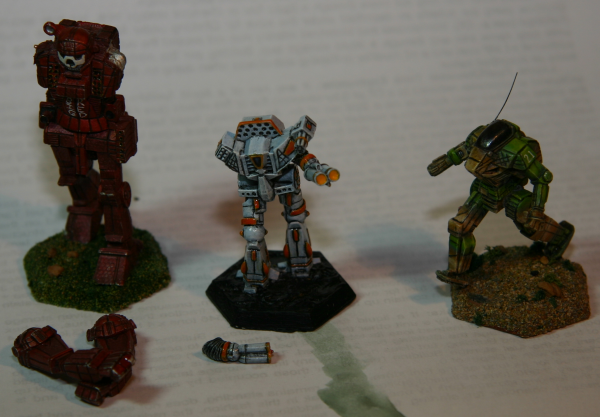
Battletech Miniatures "Big Red" was one of my first Battletech Miniatures (Atlas mini on the left). The enamel paint is badly chipped the the arms are off of it again. Though I'm always tempted to strip off the paint and redo it completely, I like to keep it as an example of how much my painting has changed in the 7 years or so since I came back to painting miniatures as a hobby. It's in bad shape though, so I need to do something about it.
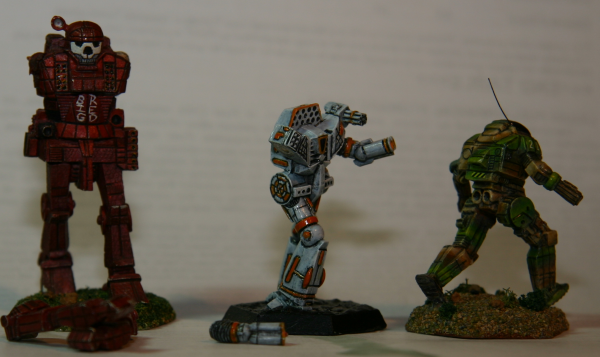
Battletech Miniatures The other miniatures in for repairs are a dis-armed Initiate and an Assassin. This Assassin is another one of my reposed minis, again running instead of standing. Because it is pinned to the base through the left leg, it has a tendency to break free and swing around on the pin. Both minis will get CA glue where they need it.
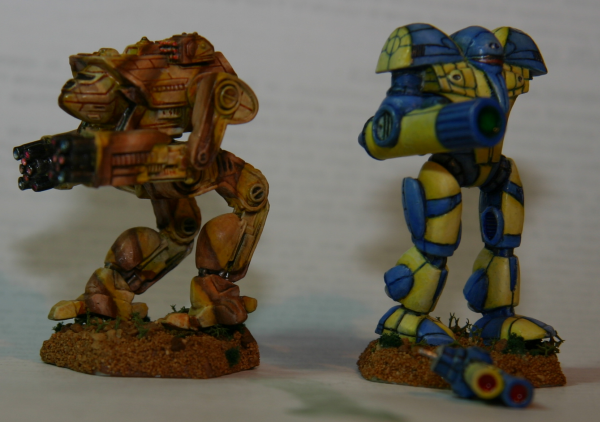
Battletech Miniatures Next up are a Daishi and Night Gyr. The Daishi (left) is modified to a walking pose, and I cut and pinned the left "elbow" to put the arm in an extended position. This required me to do a bit of sculpting with green stuff (plumbing putty) to make it look right (part of my ongoing quest to learn how to sculpt). This arm is a bit of a weak point and the putty has split from the metal where the joint is pinned, making a crack in the paint. I was hoping a bit of glue would mend it well enough that no one will notice. Unfortunately, it's fairly visible if you look closely.
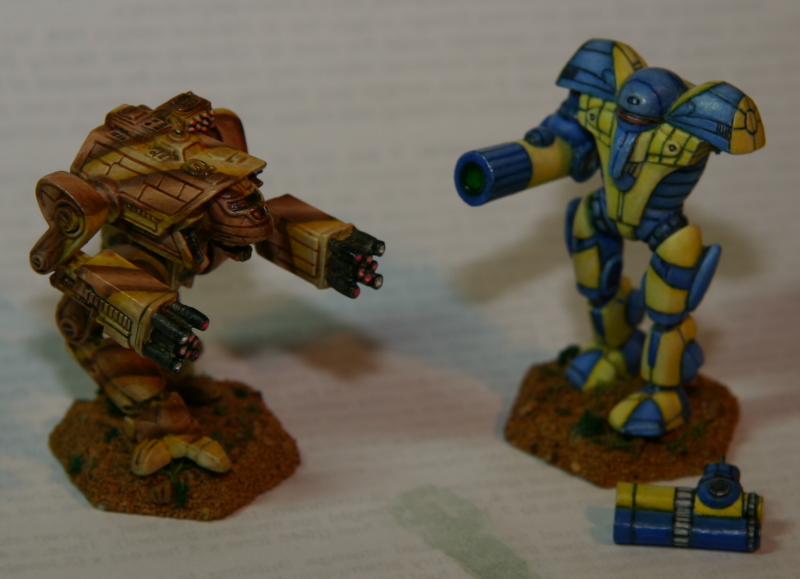
Battletech Miniatures The Night Gyr (right) saw some rough service 2 years ago at GENCON and needs both arms to be reglued (I really have been putting this off too long). This has a very basic panel scheme, but I worked really hard to get smooth shading on it, which turned out nice.
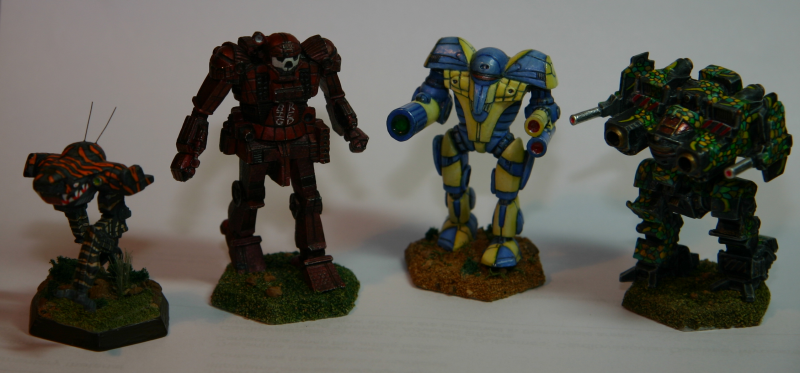
Battletech Miniatures Here is "Big Red" again after getting touched up. I panel painted some parts so it is no longer solid red, and I think the contrast make it look more distinctive. I used acrylic paint on top of enamel though, so it will probably chip off again soon.
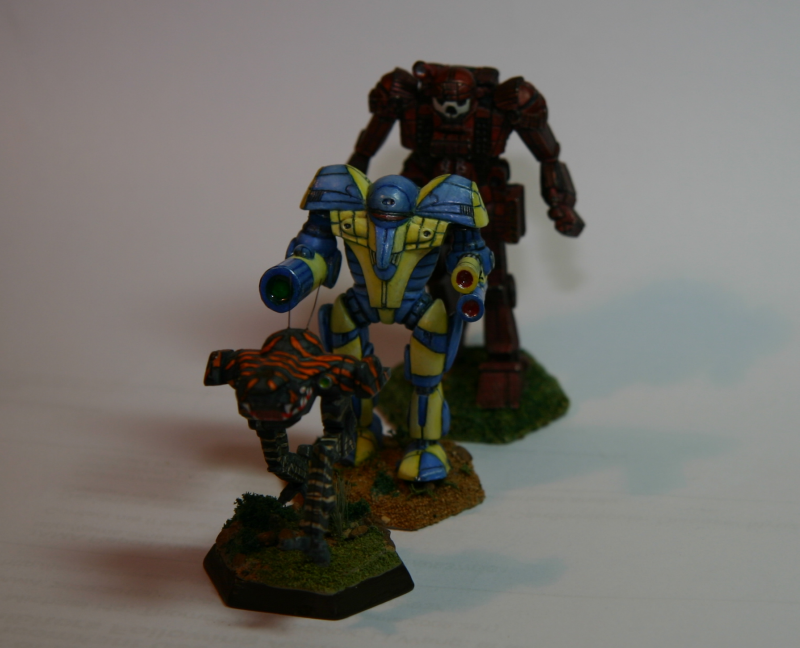
Battletech Miniatures The Night Gyr is ready for action again too.

This series was originally going to be just three parts, but I've got enough for at least two more parts.
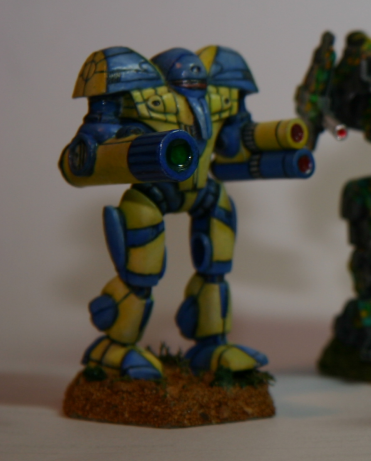
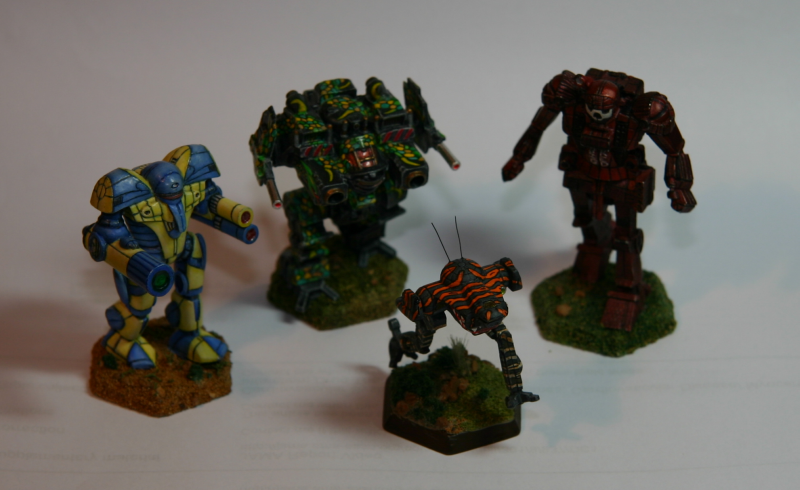
Battletech Miniatures

GBR Giant Battling Robots Favicon

15 May 2009

Darius Kazemi Takes Good Notes

In preparation for the Game Design Concepts class I'm signed up for this summer (taught by Ian Schreiber), I'm doing some reading on the topic. This is from Darius Kazemi's blog: Tiny Subversions, and is an interesting summary of Ian's GDX talk.
Here are my raw session notes for Ian Schreiber's GDX talk, Duchamp, Pollock, Rohrer: Games as the Next Avant-Garde. This is my best attempt at a transcription of what he said. Any mistakes or misinterpretations are mine and mine alone. My comments are in square brackets.
GBR Giant Battling Robots Favicon