Showing posts with label science. Show all posts

26 March 2011

Fun with Physics Special Topics

I recently discovered the online journal Physics Special Topics (current issue, archives). These are essentially collections of student articles on various topics. Here is how the journal describes itself:

FOCUS AND SCOPE
This is an undergraduate journal for year 4 (MPhys) students in the Department of Physics and Astronomy at the University of Leicester. The journal accepts brief papers on topics original to the authors. It does not accept reviews or summaries of other peoples work. It is managed by an editorial board which rotates round the student body overseen by a member of staff. The journal forms part of the assessed element of the MPhys degree. Assessment is by number and quality of accepted publications and referee reports.

The students are writing serious article on a wide variety of topics, some of which are inspired by by games and science fiction. As science goes, these is not exactly cutting edge, but it sure is fun. Some of the articles that caught my eye are:

How Heroic is a Hero? An exploration of the probability distribution behind character creation in the D20 system.

Niven Rings looks at some of the physics of Larry Niven's Ringworld.

Can superhuman muscles stop bullets?  Ask the question, "Just how bulletproof is Superman, anyway?"

And much more.

This is perhaps slightly off the usual theme of this blog, but surely playing games and reading SciFi has raised a few of these questions in the minds of gamers - "Just how what that work, if we actually tried it?" - Like many things, the fun is in the finding out. 

If one of these articles catches your interest, please post about it below. Have fun!

05 November 2009

A few hours in the library

As the saying goes among those engaged in research, "A few hours in the library can save you a few months in the laboratory". (The order is sometimes switched to turn this into a joke, "A few months in the laboratory can save you a few hours in the library".). In my case, a few minutes with Google may save me a few months of banging on a spreadsheet program or R program trying to puzzle out some difficult mathematics. Earlier today I made an interesting find:
[subscription access required for the article, otherwise you just see the abstract.]

This is a recent article that describes a mathematical model closely related to something I'm trying to work out for Battletech. The probability distribution that describes how long a Battlemech will survive during play is very complex, which is no surprise, but then I discovered I was still underestimating the problem. The article above describes a type of situation similar to what occurs in Battletech, and demonstrates a nice matrix based approach to formulating the problem.

The "phase" in Phase-Type distribution refers to the particular state of the system. In Battletech terms, the starting phase would be an undamaged mech, the end phase (absorbing state) would be the head, center torso, or engine destruction, and the phases in between would represent various states of destruction in between. The diagram below (borrowed from the PhD Thesis: Aggregate Matrix-analytic Techniques and their Applications of Alma Riska, PhD), shows an example. Here the undamaged starting "phase 0" would be state "0,0" on the left, phase 1 would be any single (non-fatal) section destroyed) such as either arm destroyed (not both), which might correspond to the "0,1" and "0,2" states. Phase 2 would be any legal combination of two destroyed locations, 3 for phase 3, and so on.


The arrows connecting the states represent the probability of moving from one state to another The whole thing can be written as a matrix giving the probability of moving from one state to another at a given time. Battletech has at least 150 states, and a complex interconnections. It's complicated, but now I know it can be done, and I have a new line of study to help me figure out how to do it.

That problem is on the back burner for a while though. I am presently working on something simpler that might have more immediate and practical application. Work and home have been very busy, so progress is slow. Soon, I hope.
GBR Giant Battling Robots Favicon

20 October 2009

Carrots and Sticks

Games are increasingly being used to investigate social behavior. Here is an excellent example of an experiment in the form of a game that shows how rewards are better at persuading people than punishment.

Carrots trump sticks
for fostering cooperation

When it comes to encouraging people to work together for the greater good, carrots work better than sticks. That's the message from a new study showing that rewarding people for good behaviour is better at promoting cooperation than punishing them for offenses.
See the full article at Not Exactly Rocket Science.   GBR Giant Battling Robots Favicon

02 September 2009

ITATSI: A Weasely Word Game

Serendipity is a wonderful thing. Comments on my other blog lead me to contact the author of Itatsi, a game based on a simple search algorithm presented in Richard Dawkins book The Blind Watchmaker. First though, a description of the game itself:

Itatsi word game
The ideas is very simple, starting with 50 strings of three random letters, pick one that will be the parent of the next generation. With each new generation there is a random chance each letter will be randomly replace by another letter. The game has a database of some 30,000 words (3 letters or more), and choosing a parent that spells one of these words will score points - more points for longer words. In the example below there is also a chance the string will become longer, allowing longer words to be found.
The game also gives a "fitness" score, when is related to how close the parent string is to other words in the database. A higher fitness indicates a greater chance that the next generation will contain words that can be scored. Each word can only be scored once, so the strategy is to choose parents that not only score points, but also lead to new words that can be scored.

I'll be describing the screen-shots as I go along, but you might find it easier to see if you open another tab or window.

Itatsi game Weasel algorithm blind watchmakerThose are the controls for starting the game (most of them). Word length controls the number of characters randomized. Remember that longer words also score more points. For this example I'm playing with variable length words. For starters you will want to select "Training Weasel: Yes".

Itatsi game Weasel algorithm blind watchmakerSo here is the first turn or "generation" of the game. It doesn't say, but because about half of the 50 children are "CAU" it appears that "CAU" was also the original parent string.
The gold or yellow "CAW" string is the child with the highest fitness, or the most likely to generate scoring words if chosen as the parent. The silver/grey "CAN" is the second highest fitness.


Itatsi game Weasel algorithm blind watchmakerThe other colors indicate children that have mutated (one or more letters changed) from the parent. Note that some of the children have randomized to become longer (4 characters instead of 3).


This turn I select the string "CAW", and the next generation will be created by randomizing that string 50 times. (below)
You can see I scored 2 points for the word "CAW" and its fitness score was 46.
Itatsi game Weasel algorithm blind watchmakerIn generation 2 the highest fitness is again "CAW" (I could choose any of them), but since I already scored "CAW", I choose "WAW" instead.
Itatsi game Weasel algorithm blind watchmakerAbove is generation 3. I scored 2 more points for "WAW", and "CAN" is now the highest fitness. The "Training Weasel" is the feature is what marks the highest two fitness as gold/silver. You will want to use this feature to learn, but the game does not track your points when it is giving you these hint.
Now here comes a a bunch of turns.
Itatsi game Weasel algorithm blind watchmakerAt generation 12 now, and you can see my chpices over on the right. "NAGS" scored 8 points. Let's zoom ahead now ...
Itatsi game Weasel algorithm blind watchmaker... to generation 20. I scored big on turn 17 (12 points for HEAL and HEALS), and another 14 on turn 18. I'm up to 7 letters now, and that might be trouble because it gets harder with longer strings.
Itatsi game Weasel algorithm blind watchmakerAt generation 38 now, and I think that's enough to give you the general idea. I had one more screen-shot to show, but I must have forgotten to save it. Too bad, because it the Weasel found the string "BEHE" (a little joke there).

In part two, I'll share my exchange with the game creator. GBR Giant Battling Robots Favicon

19 February 2009

Clue, and Minesweeping

Minesweeper gamegame clueNo, not Minesweeper, minesweeping.

Game Provides 'Clue' to Remote Sensing


This sort of makes sense; an efficient strategy to gather information in a game should be essentially the same as the strategy for finding real hidden objects. [Clue Image]

[Hat Tip 2 Purple Pawn]

01 January 2009

Mind Games

Cognitive Daily has a collection of Brain-Teaser games. Play them! It's good for you!!


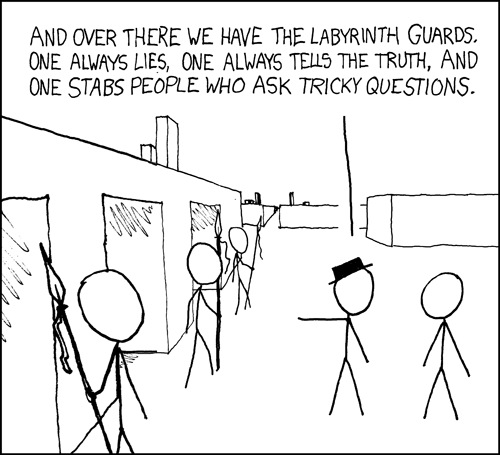
[Labyrinth Puzzle from XKCD]

Happy New Year too.