Showing posts with label Gaming. Show all posts

23 January 2011

After Action Report

I hosted a Saturday Battletech session at my home. It was a very cold morning (-11 F) and there had been a light snow - a good day to stay inside to play a game (and absolutely perfect for chilling the beer and soda!). The scenario was a rather generic "Assault" on a defended area, but I set myself some very specific guidelines for unit selection and pilot/gunnery skills.  One guideline was that all units should be selected from miniatures I actually have (which I almost accomplished), and that the battle should start off light mechs on both sides. Someone also requested I add some armor/tanks into the mix, which complicated my plans a bit. Another guideline was that the skill levels of mech pilots should be very mixed. I actually created a quite elaborate system for generating skills, and I might write that up some other day, but for now it's enough to know that about half of each force had an gunnery skill of about 4, with a range from 2 to 5. I created over 20 lances (groups of 4 units), which was MUCH more than could possibly be needed, but I wasn't sure how many people could make it or how late we might play. Pilots (and vehicle crews) were randomly generated, but within each lance I assigned pilots where I thought they were the best fit.

Each side started with 1 lance of vehicles and 2 of mechs. The mechs were all small and medium (because I stacked them that way), but vehicle selection was random, and by chance both sides started with some BIG tanks - 2 Demolisher's for the defenders, and 2 Alacorn's (heavy gauss version) for the attacker. The attackers started with an advantage of two extra medium mechs, and the only objective was to try to make the defenders "call for reinforcements" before 7 turns or so, with the idea the battle could continue indefinitely with each side alternately calling for reinforcements.


The defenders "home edge" was the lower/right corner of the photo above, and could set up on either of these two maps. Attackers entered on the far side. I was playing on the defenders side, but I stayed out of the initial setup decisions to make it more fair. Consequently, the defenders set up "forward" and took the fight immediately to the defenders on turn one (pictured above).


Here's another turn 1 photo, and it must be after combat because I see a "prone" marker in the mix. I'm not going to give all the gory detail, just a few that time and memory allow. With so many fast mechs, mediocre gunners, and big guns (on the tanks) there was a lot of wild maneuver going on. This is sort of what I was hoping would happen when I set up the scenario, and if anything it was even better than I expected.


Here's a turn 3 photo (I forgot to take any photos on turn 2). The attacker Alacorns are perched on a hill in heavy woods (lower left). They kept this position from turn 1 and made life very unpleasant (and much shorter) for several of the defenders. The defending Demolisher tanks are near the "frac tower" (upper mid) facing an uppity pair of UC/20 Saladin hovertanks.


Turn 4: The attackers have two units, a Cicada and the surviving Saladin, on the town map (lower) and are menacing a nearsighted LRM Carrier and an outmatched Flea-17. On the right an attacker Javelin is about to have a showdown with a Demolisher tank (guess who has a bigger gun?)


Another view of turn 4.

We called it quits after 5 turns. The defenders had lost 4 mechs and 2 vehicles, with 2 other mechs seriously damaged or crippled. The attackers lost 3? mechs and 1 Saladin hovertank. Had we played on the defenders would be forced to call for reinforcements immediately (well before 8 turns), so this is a clear win for the attackers. The defenders put up a good fight though, and the attackers were not too far from needing their own reinforcements.


I am quite pleased with how this turned out. The effort I put into the setup paid off with an interesting game, and the balance worked out just as had hoped. There are survivors of this battle and 14 lances of reinforcements we never got to use, so there could be a "part 2" to this battle in a month or two.

And the ice-cold beer was fantastic too. :-)
GBR Giant Battling Robots Favicon

28 December 2010

Battletech: Sword and Dragon Sessions

Image: ClassicBattletech.com
Our local Battletech group has been playing through the Sword and Dragon Starterbook scenarios.  I already posted my Mission Matrix, which has been a big help in planning missions, but I wanted to spend a little time with some other aspects of these scenarios. We have one player acting as gamemaster, two regularly attending players one each of the Fox's Teeth/Sorenson's Sabres sides, and 2-4 irregular players who sit-in as needed for the players or the OpFor. We've been having fun, but we are starting to run into some difficulties. One of our group made an especially good comment the other night as we were packing up for the evening, and I will quote him here to the best of my recollection:
JZ: "For a scenario book that is supposed to be an introduction to Battletech for new players, there are a lot of problems that only an experienced player would know how to deal with."
A lot of problems indeed. This book is intended as a sort of bridge between the Boxed Set and Total War rules, but it assumes players already know the full rules. Many missions descriptions are also quite vague as to exactly how they are supposed to be set up. Our veteran crew and GM take these problems in stride, but it would be difficult for new players to figure these things out.
The book could have done with more playtesting too, and mea culpa, I was one of the playtesters! My recollection is hazy, but we only had 18 days - enough for proofreading, but nowhere near enough time to play many missions. This also came at a busy time for most of our group, and I don't recall that we played any of these missions. This may also be a problem of having veteran players review a product intended for new players; the bugs that will trip up new players are nearly invisible to players that have been playing the game for years.

Errata problems aside, there are issues with the scenario tracks too. An inexperienced player could easily run out of WarChest Points (WP) with just a few unwise decisions. Taking the wrong combination of force and mission options (plus a little bad luck) turned into a big setback for our Sabres players. Now it's OK if players run out of WP, but I don't see how inexperienced players could avoid running into trouble. These scenarios really need an experienced gamemaster to supervise and help keep the players on a steady course.

There is another issue with these missions that is quickly becoming apparent; the scenario balance is just awful. If you play with the original mechwarriors and mechs from the book, and if the opposing force gets a few good rolls of the dice during the setup, then some of these missions can be challenging. --BUT-- If you are playing (as we are) where mechs can "lightly" modified with prototype weapons and upgrades, or replaced with other mechs purchased or captured, then the scenarios become heavy unbalanced in favor of the Teeth/Sabres sides.
I must admit my bias: I like well balanced scenarios because they are the most fun. I have been playing Battletech long enough that simply winning has little attraction for me - I want a challenge, because challenges are fun! Winning is still cool, but I want to win in a fair fight, not in some goofball setup where one side has no real chance to win (Our group even have a special name for these sort of scenarios). Consider how the following aspects of the Sword and Dragon missions lead to unbalanced scenarios:
  1. Random opposition selection is highly variable, and the players could be up against a tough fight. This encourages them to ALWAYS field the strongest lance of mechs available, even when a weaker lance might be able to pull it off with a little luck. 
  2. There are heavy penalties for not accomplishing mission objectives, so players are again encouraged to field a very powerful force, even if they might get by with less, simply because they cannot afford to lose.
  3. Random force selection does not consider that players may have upgraded their force. Even if the scenario might have been balanced originally, any improvements players make with push this towards unbalanced missions.
There is a common theme here. Given any amount of control other the scenario parameters, players will tend to optimize things for themselves even if that does not lead to a fun game. This can be OK if the other side has an equal chance to optimize, but in this sort of one-sided random scenario generation it gets broken pretty quickly. A a basic principle of good game design is broken here: There is no flow, no Fear of Failing to challenge players to the limits of their abilities.

I know I am asking for a lot. Computer games might be be able to adapt to players in this way, but can a boardgame possibly do this? The answer is yes, after a fashion. In a series of Battletech scenarios, there is no reason you couldn't have measure of performance or margin of victory, and use this to adjust the difficulty of future scenarios. To do this you need to start with a good way to rate the strength of force and opposition, which is one of the reasons I keep going on and on about point balance systems. You would also need a way to measure margin of victory over a series of scenarios. Chess, basketball, and many other games have ratings of skill and ability as measured by their performance against other players or teams. You could do this for Battletech too, with a bit of work. Finally, instead of just rewarding players for winning, make the rewards contingent on the difficulty of scenario they choose. Given the choice of an easy win or a challenging game, I think players will go for the challenge every time.

Hint: This is a topic I hope to spend some time with in 2011 (now where did I leave my notes?).

I should add a comment about scenario objectives, since there were some recent comments about objectives and balance in my recent post on Point Values for Squadron Strike. Sword and Dragon does use scenario objectives, but most of them are useless for maintaining any sort of balance, and some actually make it worse. A way to rate the difficulty of scenario objectives is something else I'm going to have to consider (and that's a tough one!).

And here is a bit of copyright info, just to make sure everyone is happy.
© 2001-2010 The Topps Company, Inc. MechWarrior, BattleMech, ‘Mech and AeroTech are registered trademarks of The Topps Company, Inc. All Rights Reserved.
GBR Giant Battling Robots Favicon

12 December 2010

Granular Skill Checks, and Interpolation

I just read a discussion in the CBT forums (Thanks PiP!) about the "granularity" of skill rolls in Battletech. The basic problem is that skill level changes in the boardgame make a BIG difference in play, but if you are running A Time Of War (Battletech roleplaying) then you want may small changes so that characters can improve gradually in many small steps - as opposed to 3-steps to a Superman.

I'll keep this discussion about the Battletech RPG, but these comments should apply to any game where characters have skill levels that seem too granular. I originally posted this whole thing in the CBT forums, then UN-posted it because what I had was broken. Now it is fixed, but much longer, so I hope nobody minds that I'm linking back to myself.

One way of doing this would be to use a different random distribution for skill checks. The second editions of the Battletech roleplaying game (Mechwarrior) uses 2d6 rolls just like the boardgame, and all skill were very granular. The 3rd edition of the game made a switch to 2d10 "exploding" dice, which greatly reduced the granularity problem, but suffered because it was difficult to make meaningful improvement in character skills.

There are also various "house rules" for doing the same sort of thing, but these generally require changing other aspects of the game to balance out the change in probability distribution. For instance you might switch to a 2d10 or 4d6 to-hit roll. There is less granularity now, which is good for your RPG, but the game has changed! On this new scale a +1 or -2 modifier will have relatively less effect or results, potentially "breaking" the usual balance of the game. You might fix this by adjusting all these modifier, but you won't ever get the original balance back this way.

I have an alternate suggestion: Add a decimal point to the skill levels, and an extra 1d10 roll when rolling for a skill check. Differences between Battletech skill level are BIG changes, so the idea is to add steps in-between. For example, instead of Gunnery 5 and 4, some possible skill levels are 5.0, then 4,9, 4.8, 4.7, 4.6, 4.5, 4.4, 4.3, 4.2, 4.1 and finally 4.0. Likewise any skill level, just adding a fractional skill level to it. There is a word for this - "Interpolation". We can interpolate between whole number skill levels, filling in with smaller changes in probability.

To use this, calculate the target number (TN) normally adding the skill level and any modifiers, and round the final number down. Make the usual 2d6 roll;
if this is less than the TN, you fail;
if this is more than the TN, you succeed;
if you roll exactly the target number, then you must also roll the 1d10, read it as 0-9, and this must be equal or greater than the decimal in your skill to succeed (if the decimal is "0" then this always succeeds, no need to roll).

Example: Suppose the base gunnery skill is 3.6, and after various modifiers the target number to-hit is 8.6, which rounds to 8. You roll 2d6 and ...
On a 9 or better you hit,
On a 7 or less you miss,
On exactly 8, you roll 1d10 (0-9), and if this is a 6,7,8, or 9 then you hit, otherwise you miss.

With TN=9 probability of success would be 0.278, and TN=8 it would be 0.417. The effect of the decimal in the skill level and the 1d10 die roll is to interpolate, or smooth out, between those two probabilities. The final probability of success for a TN of 8.6 is 0.333.

This gives 10 steps of skill improvement to every 1 in the regular rules, which ought to be fine-grained enough to satisfy the pickiest Game Master. In fact it may be too fine, and you might want to restrict it to just 5 steps (.0, .2, .4, .6, .8) or even 2 (.0, .5). Further, you will need to adjust the experience needed for fractional skill improvements accordingly. If it cost 100 experience points to improve Gunnery skill from 5 to 4, then it should cost about 10 to improve from 5.0 to 4.9. Most GM's love to tinker with this sort of thing anyway, so I'll leave the application in your capable hands (or fangs, tentacles, whatever).

Now the really good news - interpolating skills does not "break" any other parts of the game by changing the probability distribution the game is designed on, it just smooths it out, so a +1 or -2 modifier still has the same effect it always did. There is nothing special about using 2d6 with this either, so you might easily apply this to any RPG with granular skills.

Here is a chart with the probabilities of success on a 2d6 skill check. The way I have set this up makes it look a bit like a wavy staircase:
Probability of success on 2d6 with standard skills
You could walk up those steps! And the granularity is obvious. This chart has target number up to 13 because I need to show the probability go all the way down to zero for the next chart. Now a chart showing the same for interpolated "Skills with a decimal":
Probability of success with interpolated skills
Nice and smooth. If you look really hard you might notice this is actually 11 straight line segments joined together. This method of interpolation really just connects the dots between probabilities for whole number skill levels.

Now we have wiped out the granularity problem, but at the cost of some extra dice rolls. If you don't want to roll so many extra dice, you could make a single 1d10 interpolation roll (after fire declaration) and apply it to all skill checks results for that turn. This will be weirdly granular, because it is like changing your skill level randomly from turn to turn, but it will average out to the same effect over the course of many rolls.

GBR Giant Battling Robots Favicon

18 November 2010

Sword and Dragon Mission Matrix

Our local Battletech group has been playing through Starterbook: Sword and Dragon, and we are having a lot of fun doing it. Peter, my cohort in planning for team Fox's Teeth came up with this state diagram as a way to follow the possible mission tracks, to help us plan in advance:


Nifty, but very difficult to follow as many of the arrows are on top of one another. This put the idea in my head to redo it in matrix form. This entailed repeating most of the work Peter had already done, but in the process I gained a much better understanding of how the Warchest Point system works. I'd never paid much attention to this before, so it was worth the effort:


The left-hand side lists the possible current missions, along with prerequisites and Warchest Points (WP), number of 'Mechs in the scenario, and WP rewards for a successful mission. If you follow the row for the current mission over to the right-hand side you can see what missions are available following the current mission. There is a "1" in the cell if that mission can be played next, and blank otherwise. I also added color codes for missions that are only available to either Fox's Teeth or Sorenson's Sabres. This has been corrected for the published errata too, so if you are looking for the mysterious Probe or Holding Action missions, they have gone away. You can download this in spreadsheet format:

Download as Google Docs spreadsheet.
Download as Excel 2003 spreadsheet.
Download as Excel 2007 spreadsheet.

The Creative Commons license I apply to this blog obviously can not apply material derived from this Catalyst Game Labs product. However, I would appreciate being credited as author if you pass this on. The Mission Matrix form is an idea I will develop for my own purposes. Send any suggestions or comments along too, and I'll see about working them in.

I should probably blog about the play sessions too, because there is a lot going on there. Not tonight tho, it's late!
GBR Giant Battling Robots Favicon

15 October 2010

10 Games To Be Forgotten

image source
As a follow-up on my contribution to the 15 Games That Will Always Stick With Me meme, my better half suggested "10 Games I Would Rather Forget" as a follow up. The rules are a simple modification of the previous ones:
The rules: Don't take too long to think about it. List 10 games you've played that somehow didn't click with you. These might good games, but something about them wasn't fun, a game that just didn't reach its best potential, or even a bad experience with a game you really like. List the first 10 you can recall in no more than ten minutes. Pass the meme along if you can, and link back so other can follow the responses (or just post them here).

To be clear, I intend to include games I like and play,


  1. Striker (GDW) - Miniatures rules for Traveller, with a detailed construction system that let you create you own soldiers, weapons, armored vehicles and aircraft in the full range of Traveller tech levels. VERY COOL. The down side is that it came with no very little in the way of pre-designed soldiers, weapons, armored vehicles, or aircraft, so if you wanted to play you had to create all of these things for yourself. This meant hours of paperwork and hand-calculations (this was 1981) to create the gun you wanted to mount in a fast scout tank, only to find out that it was too heavy and you have to redesign the gun or redesign the tank. Very frustrating. File this under "Too far ahead of it's time."
  2. D&D - Yes, this was on my "Stick With Me" list too, but this time I am specifically referring to persons or player groups that were just unbearable. My example is a Dungeon Master who only wanted to feed his own ego, and letting him be in charge of running the game was just a bad idea. File this under "Bad Experience."
  3. Mechwarrior 3 - The Lifepaths character creation system from this RPG is practically a game in itself, and is perhaps it's best aspect. Character creation can also be tortuously complex, so it's also a bad aspect. After all this work, you either end up with a character that is mediocre at everything, OR, if you work extra hard to twist things to turn out a certain way, you could actually have a really good skill level in one area. None of this matters much, because the 2D10 exploding dice skills system tends to minimize the importance of skills anyway. File this under "Why did I bother?"
  4. Life - Sort of a personal thing, but I got "fired" in the game shortly after losing a real job, and it stung. File this under "Well, that sucked."
  5. Trivial Pursuit - Fun once in a while, but the amusement quickly fades. There's little worse than being stuck in a group of people who are keen to play "just one more round" after you have already played 2 or 3 games. File this under "Enough Already."
  6. Battletech Total War - Battletech is another game from my "Stick With" list, and the single game I have played more than any other. - BUT - The were some rules changes in the new Total War edition of Battletech that never should have been. The Battlemech will always own this game, but in older editions it was possible to play armored vehicles (tanks!) and have fun challenging the new kings of battle. Under the Total War rules, already weak vehicles were totally emasculated by critical hits and motive hits. In a typical game, your vehicle is quickly immobilized, and then it explodes. If you are lucky enough not to explode, then you can enjoy playing a pillbox for as long as you can (but usually not long). The critical and motive hits rules are a good addition to the game - they add interest - but they are unbalanced. This has sort of ruined vehicles as being interesting and fun, where they used to be a good feature of the game. (Don't ask me what I think about WiGE's.) Mea Cupla: You will find my name among the playtesters for this book; I complained then, but now I wish I had complained louder. File this under "I'm going to catch some heat for this."
  7. Diablo - I enjoyed playing Diablo, until I tried playing it online. I thought I knew what "bad behavior" in online gaming was, until I tried playing it online. If the transcendence of WoW is any indication, some of those issues with early online communities have been worked out. I sure hope so. File this under "Does not play well with others."
  8. Zynga games - 'Nuff said (but I'm lookin' at you, Facebook.). File this under "Exploitation of privacy."
  9. The Lottery (most any lottery will do) - Otherwise known as a tax on people that can't do math. File this under "Tax the poor."
  10. Dawn Patrol (TSR) - I like air combat games, or at least I think I do, because I own a small  fleet of them. I don't own Dawn Patrol, but it illustrates a serious flaw. I expect an air combat game to be about crafty maneuvers and outwitting your opponent in an aerial duel. In Dawn Patrol the planes are generally mobile enough to get a good shot at whomever may have moved before them, and moving first is a death sentence. There is no strategy, no outwitting your opponent, just luck in who happens to move first or last. Interestingly, this same thing often occurs in Batteltech, with 'Mechs forming a "conga line of death". The outcome in these situations is much more uncertain in Battletech, and the player generally has a chance to either escape or go down fighting. File this under "Barely Interesting."

That's my 10, pass it on and link back (please). Or not.

06 October 2010

15 Games That Will Always Stick With Me, Too

I picked up this meme from D20 Sapphire's post at 20 Sided Woman:
The rules: Don't take too long to think about it. 15 games you've played that will always stick with you. List the first 15 you can recall in no more than fifteen minutes. Tag fifteen friends, including me, because I'm interested in seeing what games my friends choose.
You can probably tell this originated from Facebook, but like my friend Sapphire I'm going to skip the tagging part and link back to her instead. When I started my list I thought I would have trouble coming up with 15 games, but within 5 minute I was already trying to decide which ones to leave out. SO many choices! At risk of over-thinking the question, I have split this into two parts: board games/RPG's and computer/console game (of any sort), and Honorable Mentions are included along the way. Each will be roughly in chronological order, starting with the board games:
  1. Risk (Parker Brothers) - I would go to slumber-parties with my friends and play Risk and Monopoly for 12 hours straight, fall asleep, then wake up and play for another 12 hours. We never got tired of playing (but we did eventually get tired). Honorable mention: Monopoly.
  2. Dungeons & Dragons (TSR) - Starting from the blue box, I played all I could when I was a young teenager.
  3. Ogre/GEV - Originally published by Metagaming, and Steve Jackson's first published game. This was my introduction to the "map, chits, and dice" wargame. Honorable mention: Warpwar, also by Metagaming.
  4. Air War (SPI) - I'm skipping a bunch of other games to list this one. I played many combat/battle board games, but Air War was sort of the apex of these games for me. Air War is quite complex, and as much a simulation as it is a game. Honorable Mention: Armor (Avalon Hill?), a great tank combat game.
  5. Traveller (then GDW) - Science Fiction role-playing. I played quite a bit, but it wasn't until I hooked up with a college gaming group that it really started to shine for me.
  6. Champions (Hero Games) - Another game I found in college, and with the same game master, my friend Pat (who also GM'd Traveller). Honorable mention: The Fantasy Trip (Metagaming) - Another game by Steve Jackson. This was an a very simple RPG based on the Microgames Melee and Wizard, and the basis of the two best fantasy RPG campaigns I ever played (One GM'ed by Pat, again!).
  7. Battetech (then FASA, now Catalyst) - Fastforward about 10 years - graduation, job, grad school, job-hunting, marriage - where I didn't play board games at all. I did play some computer game version of Battletech, Solaris 3025 (online) and Mechwarrior 2, and I bought a rulebook so I could understand the computer versions better. I wan't until I took a job in Milwaukee, started going to GENCON (when it was still here), and fell-in with a group of die-hard Battletech players that I really learned to love the board game. Maybe more importantly, Battletech re-awakened my love of painting miniatures, something I still enjoy just as much as playing.
  8. Squadron Strike (Ad Astra Games) - 3D science fiction space combat, and I get to help the author with some of the mathematical aspect of the game too - something I ought to be writing about!
And now the computer games, which I hate: 

  1. Asteroids (arcade) - I plunked a lot of quarters into arcade video games, and this is the game that started it. Gamers much younger than me won't recall a time when video and computer games didn't exist, but I do. I'd like to think that all of today's gamers would still be gamers even if there were not any electronic involved at all, but for many kids today, computer and console games are all there is (which is sad). Honorable mention: Donkey Kong.
  2. Hack/Rogue - This amazing little dungeon crawl game was being passed around among the computer science students when I was in college, and I found it incredibly addicting - and still do. I have a version on my Palm Pilot now, and still play it from time to time. Honorable mention: Empire.
  3. Harpoon - A computer version of Larry Bond's miniatures game, and a great naval warfare simulation. Honorable mention: 688 Attack Sub and Sea Wolf - Two submarine simulations that I spent a lot of time with. These games typically have long intervals of increasing tension as you hunt your target (or vice-versa), punctuated by a few minute of heart-and-keyboard-pounding excitement when the torpedoes start to run.
  4. Master of Magic - Sort of a cross between Civilization and Magic, the Gathering. This game offered many different choices during setup that allowed for variety and interesting play.
  5. MUME (Multi Users in Middle Earth (MUD) - A text-based "dungeon" adventure devoted to re-creating Middle Earth. This was my first experience in online gaming, and a terrible this to discover during graduate school, because it threatened to suck-up my every waking moment. I was never able to get a fast connection though, and this generally resulted in BAD things happening to my characters when this started getting tough, so I finally wised-up and focused on studying instead. I still log in every few years to see if there are still any of the old players still playing there (and there are). Honorable mention: Doom + Quake - Two games I refused of purchase because they definitely would have made me flunk out of grad school.
  6. Starcraft - I've got to have an RTS in here somewhere, don't I? 
  7. Gran Turismo 2 (Playstation) - The only console game I'm listing here, because it's the only console game I've spent much time with. Even then, I had to get up early on Saturday mornings to run the longer races (100 laps) before my son want the PS2 for himself. This isn't so much a game as it is a driving simulator, and it's as close as I'll ever get to driving a real performance car too. I have the newer editions of the game too, but they don't have the same memories.  Honorable mention: Netrek - Another online multi-player game, one if the first of its kind, and a whole lot of fun. This got demoted to "mention" status because I haven't actually played it all that much.
That's my 15 games I'll always remember, but I already know what number 16 will be:

Honorable mention: Gratuitous Space Battles - My first computer game purchase in a long time, and I am really loving it. Look for a proper review on these pages sometime soon.
GBR Giant Battling Robots Favicon

13 January 2010

Go with the Flow

Some more psychology today, with a relation to games. Better yet, click on over to HappenChance and read the original article: What is Flow?

Have you ever become completely lost in your favorite activity? Lost track of time? Felt focused, energized, and completely unselfconscious? As if your body and mind were working in perfect harmony?

If so, you may have experienced something by described by the Hungarian professor Mihaly Csikszentmihalyi as the Flow state. In his book Flow: The Psychology of Optimum Experience, CM explains what Flow is, when people experience it, and why it’s so important.

Athletes call this ‘being in the zone.’ Buddhists might call this simply mindfulness or low-level nirvana. The Greeks would describe this as being taken over by the muse.

Whenever you see an amazing performance or creation, it’s a safe bet to assume the performer or creator was experiencing flow.

I can't count how many times I've lost track of times while playing games, or painting, or reading or exercising, or ... well, you get the idea.

Everything I’ve read suggests that most people find flow while doing one of two things: hobbies they love or working at their job. The latter is a little surprising, as a lot of people will tell you they don’t like their job. Jobs, though, have all several of the components required for flow: a rule-based system, feedback, clear and definable goals.

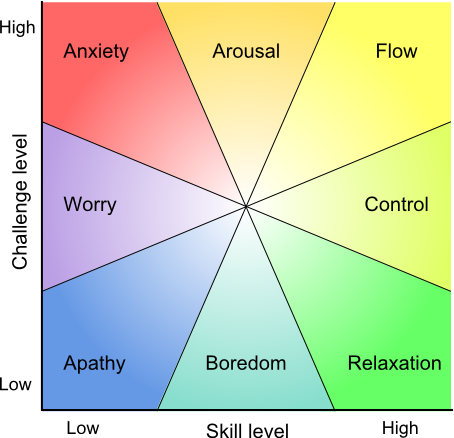
A person is most likely to find flow while engaged in an activity where the challenges match the skill level. During low-challenge activities, people become bored. If an activity is too challenging, they experience worry and anxiety. The chart below describes when people are most likely to experience flow.

Flow diagram


And finally, the tie-in with games:

Video games seem to be designed with flow in mind. People have written papers on such things. Jenove Chen, for example. Why are games so likely to help people find flow? They have all the attributes required for finding flow: a system with clear rules, immediate feedback (scores), goal-based challenges. They also require full concentration, engagement, and a certain amount of skill.

At some level, I think flow is what I'm trying to achieve out of all games.
GBR Giant Battling Robots Favicon

08 September 2009

Paper Figure Generator

Stages RPG paper fugure generatorThe Stages RPG site has a feature that lets you create your own paper figures, which can then be cut out and assembled. That might be handy for your next RPG game.


Attack Vector Tactical ship boxes AV:TIf this printed all 6 sides instead of just two, you could make your own Squadron Strike and Attack Vector: Tactical ship boxes.

[UPDATE] Ad Astra Games has an application to create six-sided box figures as part of their subscription service for Squadron Strike.

25 June 2009

ORIGINS 2009: Photo Album

You can find all my photos of ORIGINS 2009 in my Picasa Web album.
http://picasaweb.google.com/EastwoodDC/ORIGINS2009

ORIGINS 2009 BattletechMy connection is very slow this morning, but I will try to get more pictures up later.

[Update]
I had a really great day, did interesting things and met fascinating people. Now all I need is time to write about it!

GBR Giant Battling Robots Favicon

ORIGINS 2009: Day 2 - Gaming Tables

ORIGINS 2009 Miniatures Tables


ORIGINS 2009 Miniatures Tables


ORIGINS 2009 Miniatures Tables


ORIGINS 2009 Miniatures Tables
I have a fondness for miniature terrain tables. Even though I don't play on them all that often, I just like seeing them set up and ready for play.


ORIGINS 2009 Miniatures Tables
These last two are for a Battletech event (Operation Whitetail, Day 1), but he wasn't sure that he would have enough players for a game.

ORIGINS 2009 Miniatures Tables


~GBR Giant Battling Robots Favicon

ORIGINS 2009: Day 2 - Duke Seifried

ORIGINS 2009 Duke Seifried
I think I'll let the Pictures say it.

ORIGINS 2009 Duke Seifried


ORIGINS 2009 Duke Seifried


ORIGINS 2009 Duke Seifried


ORIGINS 2009 Duke Seifried

ORIGINS 2009 Duke Seifried

~GBR Giant Battling Robots Favicon

24 June 2009

ORIGINS 2009: Day 1

Not too much to report. I spent much of the day driving and getting settled into my room. I can't believe how much stuff I brought, but that's what I get for packing at the last minute (bring it all, figure out what I need later). I spent much of my evening with a local relative, but got back in time to sort out a badge/ribbon issue, and get in a game on the Battletech Pods before retiring for the evening. The Pods are ... fun ... REALLY fun ... I might have to mortgage the house (it's a good thing I didn't bring the deed!).
GBR Giant Battling Robots Favicon

11 April 2009

Gygax and Arneson, in Memorium

In the spring of 1978, I began a most interesting journey. One of those journeys that changes your life. Two of them actually.

Wideview Utah desertOne was a school trip, with about 40 kids and chaperons packed into 8 station wagons, setting off on an 11-day tour of Wyoming and Utah. Great fun. Memories to last a lifetime. A story for another day, perhaps. [Image Wideview]

Then there was the other journey. Five 13-year-old boys in a car on a long drive across the desert do get bored. There were two pretty girls in the car too (S and J), but we hadn't figured that stuff out yet. What we did have was a box. A game in a blue box that none of had seen before.

Basic D&D Dungeons and Dragons AcaeumWell, that's not exactly right; one of us had. Matt pulled this blue box out of his knapsack and introduced us to a game that had no board and no pieces to move. It used pencil and paper, but we had that in abundant supply (school trip, you know). It also used some dice I'd never seen before, with 4, 8, 12, and 20 sides, in addition to the usual 6 sided dice. We created "characters" by rolling attributes and decided what classes they should be. [Image Acaeum]

Characters needed names, and fortunately we had all recently seen the Ralph Bakshi movie Wizards which provided a lot of inspiration.
Sean had high wisdom and became a Leric? the cleric. Manus got high intelligence and was a magic user (name?) with a unique fashion sense. Taylor got the highest dexterity and was Avatar the thief. John and I got good strength and constitution and took the fighter roles of Elric? the elf and Peace the dwarf. Matt ran the show as the game master.
[Image IMDB, and if you are an RP gamer and have never seen Wizards, shame on you!]

Wideview Utah Glenn canyon damAnd so we passed the time on the long long drives between stops on our trip. Battling skeletons, stirges, and other perils, and gathering up all the loot we could carry. I have a lot of good memories of that trip, which was really extraordinary by any measure. Some of those memories happened in the back of a station wagon, rolling down the Utah highway. [Image Wideview]

In the past 13 months we have lost Gary Gygax and David Arneson, the two people who created Dungeons & Dragons, and who enabled a lot of those good memories I've been writing about. That is the way of things; people pass on leaving only memories.
Though I gave up this particular game long ago, gaming remains a part of my life. I am not alone, because a lot of other people have been drawn to role playing games as a pastime and hobby. A lot of them started with the blue box or something very like it, just like my friends and I did in the back of that station wagon. Somehow I think the influence these two men had on so many people will not be forgotten any time soon.
GBR Giant Battling Robots Favicon

[Update: With some help from Matt, we determined this must have been the spring of 1978, not 1977. Therefore most of us were actually 14 years old, not 13. There are some additional comments on Facebook.]

18 March 2009

Giant Battling Robots at ORIGINS 2009

I will be attending the ORIGINS Game Fair in Columbus, Ohio on June 24-28. At this point I have no plans to run any Classic Battletech events as I have in the past, though I may offer to help out a bit. I do plan to play in as many different events as I can and collect ideas to write about. In the past there have been some interesting military history seminars I wanted to attend, but was too busy to get to them. This year I will have most of my time free to spend as I like, and I'm really looking forward to it.

Origins game fair
So ... is anyone else out there headed to ORIGINS this year? If there is enough interest we might set up a Blog-n-Grog meeting. :-)

20 February 2009

Ad Astra on the Move

Ad Astra Games Squadron Strike gameAd Astra Games is relocating, with offices in Minnesota and Ken Burnside (President/Creative-guy) in Milwaukee. I met Ken last week while he was running a Squadron Strike demo at my local gaming haunt.


Ad Astra Games Attack Vector: Tactical game


If you are not familiar with Ad Astra Games, they are the makers of games based in real physics and engineering, such as the award winning Attack Vector: Tactical, Saganami Island Tactical Simulator (SITS), and Birds of Prey (which I now own and hope to review soon).


Ad Astra Games Birds of Prey modern air combat game
I expect Wisconsin gamers will benefit from having Ken in the area for demos, and I might sign up for his Squadron Strike campaign, time permitting.


Ad Astra Games SITS Saganami Island Tactical Simulator game