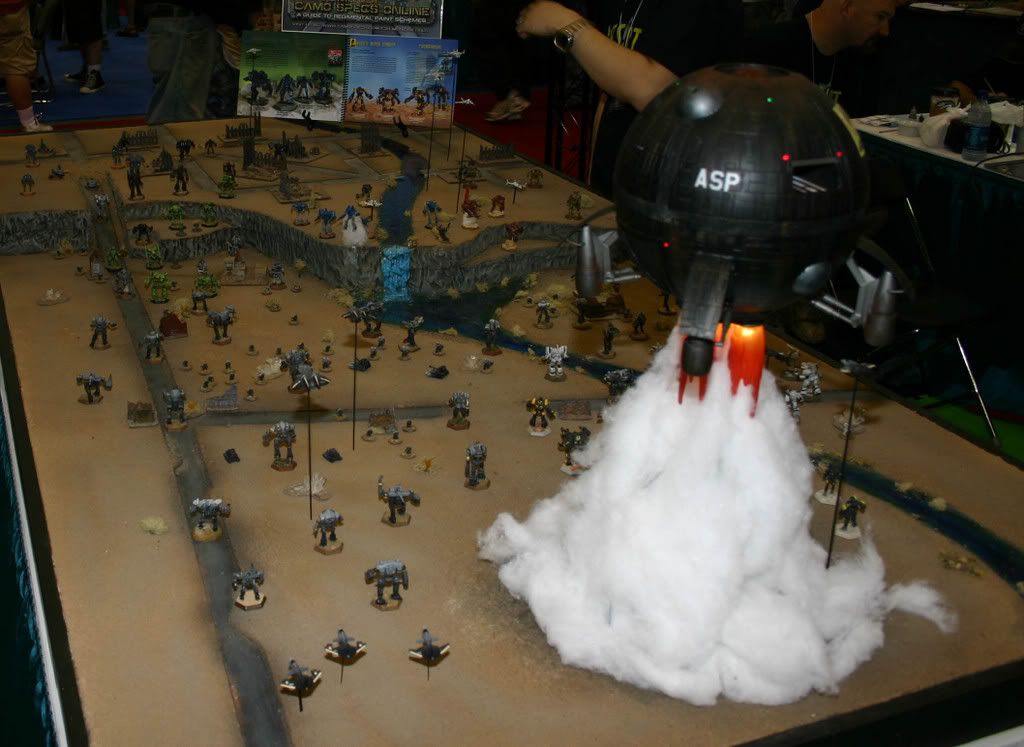
More images of the 2007 Camospecs diorama on my p-bucket albums. Blame Steven Satak for the incredible Union dropship model.
28 November 2009
Engine 371
No robots today - This is a short film - Engine 371 by Kevin Langdale about (stay with me here) the Canadian Transcontinental Railroad. It's also a model railroader's dream come to life, and illustratse how model railroad enthusiasts see their creations.
Battletech players Gamers are the same way about their miniatures and the game worlds they come from. The imagination lets it come alive and surpass the borders of the table top.
More images of the 2007 Camospecs diorama on my p-bucket albums. Blame Steven Satak for the incredible Union dropship model.
05 November 2009
A few hours in the library
As the saying goes among those engaged in research, "A few hours in the library can save you a few months in the laboratory". (The order is sometimes switched to turn this into a joke, "A few months in the laboratory can save you a few hours in the library".). In my case, a few minutes with Google may save me a few months of banging on a spreadsheet program or R program trying to puzzle out some difficult mathematics. Earlier today I made an interesting find:
This is a recent article that describes a mathematical model closely related to something I'm trying to work out for Battletech. The probability distribution that describes how long a Battlemech will survive during play is very complex, which is no surprise, but then I discovered I was still underestimating the problem. The article above describes a type of situation similar to what occurs in Battletech, and demonstrates a nice matrix based approach to formulating the problem.
The "phase" in Phase-Type distribution refers to the particular state of the system. In Battletech terms, the starting phase would be an undamaged mech, the end phase (absorbing state) would be the head, center torso, or engine destruction, and the phases in between would represent various states of destruction in between. The diagram below (borrowed from the PhD Thesis: Aggregate Matrix-analytic Techniques and their Applications of Alma Riska, PhD), shows an example. Here the undamaged starting "phase 0" would be state "0,0" on the left, phase 1 would be any single (non-fatal) section destroyed) such as either arm destroyed (not both), which might correspond to the "0,1" and "0,2" states. Phase 2 would be any legal combination of two destroyed locations, 3 for phase 3, and so on.
The arrows connecting the states represent the probability of moving from one state to another The whole thing can be written as a matrix giving the probability of moving from one state to another at a given time. Battletech has at least 150 states, and a complex interconnections. It's complicated, but now I know it can be done, and I have a new line of study to help me figure out how to do it.
That problem is on the back burner for a while though. I am presently working on something simpler that might have more immediate and practical application. Work and home have been very busy, so progress is slow. Soon, I hope.
[subscription access required for the article, otherwise you just see the abstract.]
This is a recent article that describes a mathematical model closely related to something I'm trying to work out for Battletech. The probability distribution that describes how long a Battlemech will survive during play is very complex, which is no surprise, but then I discovered I was still underestimating the problem. The article above describes a type of situation similar to what occurs in Battletech, and demonstrates a nice matrix based approach to formulating the problem.
The "phase" in Phase-Type distribution refers to the particular state of the system. In Battletech terms, the starting phase would be an undamaged mech, the end phase (absorbing state) would be the head, center torso, or engine destruction, and the phases in between would represent various states of destruction in between. The diagram below (borrowed from the PhD Thesis: Aggregate Matrix-analytic Techniques and their Applications of Alma Riska, PhD), shows an example. Here the undamaged starting "phase 0" would be state "0,0" on the left, phase 1 would be any single (non-fatal) section destroyed) such as either arm destroyed (not both), which might correspond to the "0,1" and "0,2" states. Phase 2 would be any legal combination of two destroyed locations, 3 for phase 3, and so on.
The arrows connecting the states represent the probability of moving from one state to another The whole thing can be written as a matrix giving the probability of moving from one state to another at a given time. Battletech has at least 150 states, and a complex interconnections. It's complicated, but now I know it can be done, and I have a new line of study to help me figure out how to do it.
That problem is on the back burner for a while though. I am presently working on something simpler that might have more immediate and practical application. Work and home have been very busy, so progress is slow. Soon, I hope.
27 October 2009
Pilgrimage To Mecha
[From The Escapist magazine]
How about a quick unscheduled trip to Japan to explore their love of all robots, giant and battling?
But enough of my ramblings. Go read John Funk's Pilgrimage to Mecha for yourself.
Make no mistake: Gundam is a big deal in Japan. To put it in context for a Western audience, Gundam is the Japanese equivalent of Star Wars, complete with an iconic masked antagonist, laser swords and modern installments of dubious quality. But that comparison doesn't explain the presence of a 60-foot statue that took over two months and millions of dollars to complete.
What's so special about Gundam, anyway?
How about a quick unscheduled trip to Japan to explore their love of all robots, giant and battling?
I missed out of the Gundam shows as a kid, but somehow I still managed to find and read the first three Robotech book series. As bad as those books were, they still managed to capture my imagination.
In Japan it seems to have capture the whole country.
When I discovered Battletech through various computer games, I actually started having Battletech dreams on a regular basis. Weird? Maybe. It seemed to allow me to play out a sort of superman fantasy. I don't see myself as any sort of superman, but that particular sort of escapist fantasy does seem to be very popular.
But enough of my ramblings. Go read John Funk's Pilgrimage to Mecha for yourself.
26 October 2009
What Next?
I'm kicking around some ideas of what to write about next, and I thought I might ask my readers what seems interesting. Here is a partial list:
That's enough. Suggestions and requests are always welcome.
- Stochastic Duels: This series is stalled, but not forgotten. This will get done eventually because it is part of my "master plan".
- Fair Dice. There was a spurt of interest in this following Kit's post at the Scrapyard Armory, but I had some other ideas I still want to follow up on. These include measuring a set of dice to see how regular the casting is (I found my calipers!), and some more mathematical results about fair dice I could describe.
- A series on basic strategic choice in war games, tentatively titled "Toy Soldiers". And by basic I mean starting with the most trivial situation possible and working up to some common choices in games.
- A better Battle Value for Battletech. I've been working up to this one for a long while, and I still don't have all the pieces I need to do this right. However, doing it wrong might still be interesting. What I have in minds would also be applicable to a lot of other games too. This would be even better if I could do a little programming work to calculate the value first.
- Painting Miniatures, which would require me to get off my butt and start painting!
- There is no idea #6.
- Designing Games: I simply ran out of time for the Game Design Concepts class over the summer, but I'd like to get back to it at my own speed. I have a growing list of game ideas, and with a little effort, any of these might be fair material for posts.
- Lanchester's Laws, something else I keep threatening to write about, also part of my master plan. Hmmm ...
- I read this post about Chaos theory, and it made me wonder if that might be worked into a game somehow.
- I've got a stack of old notes I started writing before I was blogging too. I should scan through those for more ideas.
That's enough. Suggestions and requests are always welcome.
24 October 2009
2009 Chicago Golden Demon Winners
Perfect timing! Just when I was needing some inspiration to get back to my painting, the 2009 Chicago Golden Demon Winners are announced.[Note: This link may redirect you to the Games Workshop front page instead of taking to to the pictures. If this happens, select your language, and it should take you to the Golden Demon article. If that fails too, come back here and try the link again. - D]

I don't play Warhammer, but I do appreciate the work that goes into these miniatures. Some of these are simply fantastic.

I made my copies of these image small and low-quality. Consider that a suggestion to go see all the originals from Games Workshop.
UPDATE2012: The old links no longer function as intended, wither broken or redirected. Try this: http://www.games-workshop.com/gws/content/article.jsp?aId=13000009a
If you are redirected to the GDW front page, use the drop-down there to identify your country/language, then try this link again.
23 October 2009
Games and Reality are Probably Different, Part 4
In the previous posts in this series (1 2 3) I have been describing the probability distributions generated by dice and trying to describe why that doesn't quite match what we experience in reality. Not all games have dice though; some games use physics to simulate the real world, and the only random element might be the actions of the player themselves. Do these games suffer the same problem? - I think they do - but first, I need to tell you about my favorite TV show.
My favorite TV show - Top Gear on BBC television - is a mix of fast cars, testosterone, and the best of British absurdesthumor humour. The show is co-hosted by Jeremy Clarkson, BBC television host and professional overgrown child. I can call him that because I am horribly jealous of his job, which seems to consist entirely of driving fast cars and making snarky comments. Here is his mini biography:
[The video is broken, but try one of these links:
http://videosift.com/video/Top-Gear-Real-life-racing-vs-Gran-Turismo
http://en.wikipedia.org/wiki/Mazda_Raceway_Laguna_Seca#Automotive
http://www.streetfire.net/video/top-gear-nsx-laguna-seca_208766.htm
http://www.kewego.com/video/iLyROoaft0ZG.html]
The Gran Turismo games are great simulations, but they miss some of the little things that make race driving harder. While there is no random dice rolling to this game or to driving a car (1), the limitations of human reactions add an element of uncertainty and randomness. Most of the time that random aspect is too small to notice, but when it comes to doing something really hard those little things start to matter. The Game is no longer a good representation of the Reality. One of the things Jeremy points out is that a game can't make you afraid of spinning off the track, and so fear adds another layer of difficulty in the real car.
That's OK, it's supposed to be a game. If every player had to learn all the skills of a real race driver it wouldn't be much fun. As pointed out in the comments to Part 1 of this series, games don't need to have a perfect representation to give players a challenging task and tough decisions to make.
Footnotes:
My favorite TV show - Top Gear on BBC television - is a mix of fast cars, testosterone, and the best of British absurdest
Jeremy has often been described as 'the most influential man in motoring journalism', mainly by himself. Estimates suggest that he is slightly over nine feet tall, owns 14,000 pairs of jeans and has destroyed almost 4.2 million tyres in his lifetime. He is best known for possessing a right foot apparently consisting of some sort of lead-based substance, for creating some of the most tortured similes ever committed to television, and for leaving the world's longest pauses between two parts... of the same sentence. He has never taken public transport.In a recent (recent to me) segment of the show Jeremy takes on "The Corkscrew" at Laguna Seca, perhaps the most difficult corner of any race track in the world. First Jeremy first practices with Gran Turismo 4 to get a good track time, and then tries the same track in real life. (What is there about his job not to be jealous of?) See how well he does:
[The video is broken, but try one of these links:
http://videosift.com/video/Top-Gear-Real-life-racing-vs-Gran-Turismo
http://en.wikipedia.org/wiki/Mazda_Raceway_Laguna_Seca#Automotive
http://www.streetfire.net/video/top-gear-nsx-laguna-seca_208766.htm
http://www.kewego.com/video/iLyROoaft0ZG.html]
The Gran Turismo games are great simulations, but they miss some of the little things that make race driving harder. While there is no random dice rolling to this game or to driving a car (1), the limitations of human reactions add an element of uncertainty and randomness. Most of the time that random aspect is too small to notice, but when it comes to doing something really hard those little things start to matter. The Game is no longer a good representation of the Reality. One of the things Jeremy points out is that a game can't make you afraid of spinning off the track, and so fear adds another layer of difficulty in the real car.
That's OK, it's supposed to be a game. If every player had to learn all the skills of a real race driver it wouldn't be much fun. As pointed out in the comments to Part 1 of this series, games don't need to have a perfect representation to give players a challenging task and tough decisions to make.
Footnotes:
- If you want to get picky, then for practical purposes it's not possible to measure or simulate every last detail, and this error could well be described as "random".
22 October 2009
'Tis Better to Give than Receive
Forwarding some news from my friends at MechCorps. (previous posts 1 2 3)
This is a private company, but I don't mind promoting them because I think it can only help to foster enthusiasm for Battletech in general. In turn it brings a lot of traffic to my blog. Win-Win.
If you get a chance to try these pods, it can be some serious fun. I'm hoping they will be at ORIGINS again next year. Click through for a map of the Battletech Pods nearest you.
For Immediate Release:
From the convention away missions with MechCorps' Mobile Armor Division [www.MechCorps.com/concal], there is developing a strong BattleTech contingency in the land of Acadiana, otherwise known as Louisiana. The various lances in this region have asked for an event for which they can collectively attend at our Headquarters in Houston, TX and prove their piloting skills in the Virtual World, Tesla II BattleTech Pods.
MechCorps would hereby like to invite all 'Mech pilots receiving this message to the gathering on December 11 and 12, 2009. It is a low-key event that will allow for a selection of entertaining missions for New Recruits up to hearty competition for BattleTech Masters.
Details on this regional event can be found at www.MechCorps.com/GIVEit
For those who have not yet experienced the BattleTech Cockpit Simulator Pods,
the Tesla II cockpits, featuring the BattleTech: Firestorm software, are fully enclosed military style simulators that feature 7 screens, over 90 control systems, and a 12 speaker surround sound system. When seated in the pod, the player pilots one of a selection of BattleMechs onto one of 25 landscapes to compete for battlefield superiority with those seated in surrounding cockpits.
MechCorps Entertainment, LLC is the largest independent operator of Virtual World Entertainment's Tesla II BattleTech: Firestorm Cockpit Simulator Pods with it's main base of operation in Houston, Texas. MechCorps' Mobile Armor Division is the touring branch of MechCorps traveling to various conventions and other remote deployments across the United States. MechCorps Entertainment, LLC is a privately held company. Visit www.MechCorps.com for more information.
Headquartered in Kalamazoo, Virtual World Entertainment is a leading supplier of high-end, centerpiece attractions to the location-based entertainment industry. Virtual World has produced and distributed cockpits since 1989. Virtual World Entertainment, LLC is a privately held company. Visit today at www.virtualworld.com.
This is a private company, but I don't mind promoting them because I think it can only help to foster enthusiasm for Battletech in general. In turn it brings a lot of traffic to my blog. Win-Win.
If you get a chance to try these pods, it can be some serious fun. I'm hoping they will be at ORIGINS again next year. Click through for a map of the Battletech Pods nearest you.
Subscribe to:
Posts (Atom)


