30 November 2008

Survival Distributions

[OOPS. It seems I meant to publish this post almost a month ago, and now I find it is still stilling here in draft status. That is easy enough to fix {click}. It's kind of a boring post, but I thought it necessary to offer some basics of what I'm working towards.]

It is not my intent to turn this blog into a statistics textbook, but there are some topics I feel like I ought to introduce in a simple form before I launch into more complex discussions. One of these is the concept of a survival distribution.

A probability distribution is a type of function that describes the behavior certain types of random events. Most gamers should intuitively understand the probabilities that result from a single roll of a die, which is formally known as the Discrete Uniform distribution, and those with a basic knowledge of statistics will be familiar with the Normal distribution.

Survival distributions are a subset of probability distributions that can describe the probability that some length of time T will pass before an event X occurs. In the discrete case, this becomes the number of attempt or trials T until event X is observed. An example of the latter is the Geometric distribution. Here there is some probability p that the event will occur on each trial. A simple example would be: “How many times will you roll a six-sided die before getting “6” as the result. The probability of getting a “6” is p=1/6 = 0.1667, and the average or expected value is 1/p or six trials (rolls of the die) before getting a six.

Hammer's slammers survival probability game mathThe other reason for this post (the truth comes out) is that I had a nice plot left over from my previous example using the game Hammer’s Slammers, but really needed to describe the Geometric distribution first. Here is a chart illustrating the distribution of the number of attacks on a unit before it is destroyed. For example, a unit subject to 6 1:1 attacks has about 35% chance of survival (or 65% chance of destruction). As you can see, the lower attack-defense ratios (1-3 to 1-2) might require a large number of attempts before destroying the unit, but the higher ratios have very good change of destroying the target in just a few (or one) attempts.

So that, in a nutshell, is my introduction to survival distributions. In the ongoing discussion of the value of units within a game, this is going to be a key concept; the longer a unit survives within a game, the more opportunity there will be for it to be useful - to destroy the other players units - and the longer it can survive the greater its value will be. Next up (well, soon) will be an introduction to a type of survival distribution that can apply to Point Objective Games.

UPDATE: See the next post in this series.

28 November 2008

Anatomy of a Black Hawk H - Part III

I've added a few more images. Not a lot of progress to show, but some better pictures. You can find the entire gallery here. These should be images 41-46 in the gallery.

From GBR: Anatomy of a Blackhawk H

From GBR: Anatomy of a Blackhawk H
I've been working in a very thin white-green tone to even out the shading and smooth out spots I missed before. Likewise with the blue stripes, I'm lightening them with a very thin white-blue mix. I don't know if this is efficient, but it is my usual approach - multiple layers to blend the colors together.

27 November 2008

Posting policy

Posting policy for Giant Battling Robots and Dread Tomato Addiction -  It's nice to have visitors, but SPAM, not so much. I want to allow as much freedom for comments as I can, but there have to be some sort of limits too. Therefore, some rules:

  1. Any posts or links which require any significant effort or my part to determine if they may or may not be legitimate comments, or otherwise wastes my time, are subject to immediate deletion.
  2. If you want to promote your own blog*, do so by posting a relevant comments, or risk wasting my time (see rule #1). Promote yourself by participating.
  3. No p@rn. No links to p@rn (see rule #1 again). If you have a relevant comment that includes a link to adult content, then it would be polite to indicate your link is NSFW, Adult, etc.
  4. If you post in some language other than English, please give some indication of what language that is, or use an automatic translation service such as Google translate. I will not attempt to translated messages if there is no indication that it might be legitimate (see rule #1).
  5. Be polite. Do not feed trolls. Do not be a troll.
* Good for you! I'd like to help. Now go back and finish reading the rule.

Please note that comments on posts more than 14 days old are subject to moderation, and will not appear immediately.
These rules are subject to my interpretation and may change at any time. If you think you have not been fairly treated, email me your concern and I will consider it.

26 November 2008

General(s) George from Le Petit Soldier Shop

On a recent visit to New Orleans, the wife and I spend a pleasant morning exploring the French quarter near Jackson Square. After coffee and beignets at Cafe Du Monde, and a stroll through the touristy shops on Decatur Street, we started exploring some of the nearby streets. I'm glad we did.

At 528 Royal Street, we made a nice find: The Sword And Pen / Le Petit Soldier Shop. They specialize in historical miniatures and toy soldiers, both modern and antique. Historical miniatures are not my main interest, but I really didn't want to leave this shop empty handed.
---
From GBR: Public
Fortunately these two small figures caught my interest among a box of similar figures: George Washington and George Custer.
From GBR: Public
As you can see, someone started to paint the Custer figure, but didn't get very far.
---
From GBR: Public
The shop owner told me these were probably produced by the Marx company sometime during the 1960's. There are some similar figures in the Marx Toy Museum (another place to visit one of these days!).
---
I wish I'd had my camera to take some pictures of the displays, but now at least I have an excuse to go back.

23 November 2008

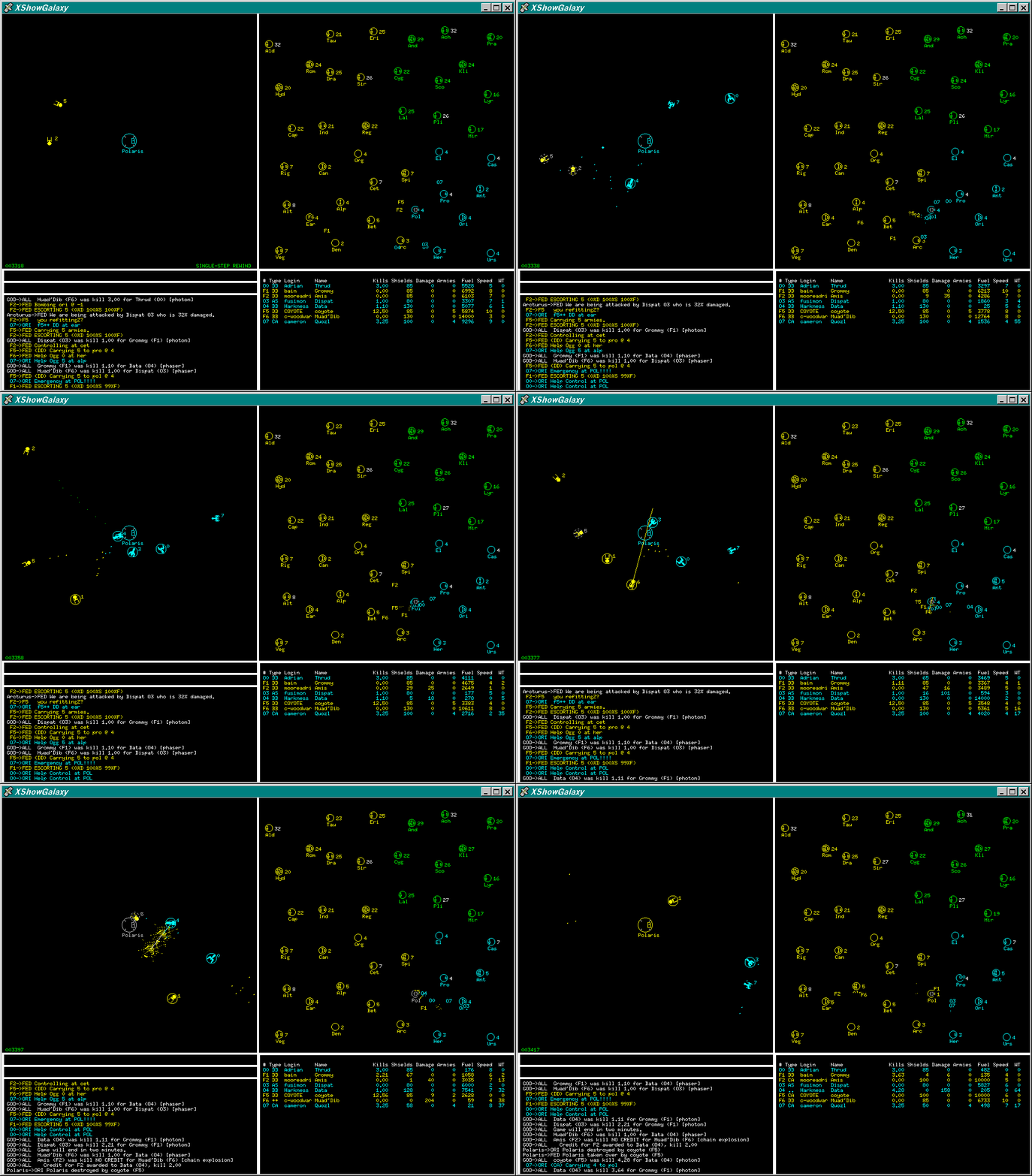
Netrek: The Greatest Star Trek Game

Last year on a dark November evening I stumbled across an old computer game, one that I had never heard of before. Little did I know that I was going to be spending a fair portion of my free time dueling with other players for control of the galaxy! NETREK is a multiplayer online game loosely based on the Star Trek universe. Up to 16 Players battle each other in 2-D ship-to-ship dogfights, and team play starts when there are enough players for 4-8 players per team (depending on the server). NETREK also has a unique distinction, not only is it a progenitor of modern online games (versions have been around since the mid 1970's), but it was the first game to really take advantage of the online multiplayer setting, making teams and team play the best part of the game.

The game itself is amazingly simple; Right-Click to change course, left click to fire phasers, "t" for torpedos, "0-9" to set speed, etc. You can learn the basics of play and rudimentary "dogfighting" skills very quickly, and there are practice servers populated with "bots" to aid you in this. Of course, basic skills won't be enough to save you from others who may have been playing for years, but they will let you begin to understand the greater part of the game - the part that transcends the Eighties-tech simplicity of the game. This is because dogfighting is only how you play against other players, it is not the goal of the game.

The goal of NETREK is to transfer armies about between planets and so take control of all the other team's planets, thus winning the game. In a game full of players who all have the basic skill and more, this becomes amazingly difficult. Teams must struggle to accumulate and defend the armies needed to "take" another planet. They must cooperate to mount a successful attack and "take", and then fiercly defend the prize from counter-attack, all the while defending their other planets for similar attacks. To do so successfully requires a level of understanding and cooperation beyond far beyond the "twitchy" skills of dogfighting. Team play arises out of the simple mechanics of the games, transforming it from a simple shooter into a strategic masterpiece as complex as any sport.

Unfortunately, life started making other demands on my time, and my time for NETREK became very limited. Then there was the lightning strike in the spring that fried various bits of electronics about the house, including the network card on the computer I use for games, which ended my NETREK play entirely. Winter is coming around again though, and with it I'll be spending more time indoors looking for something to do. I now have a brand new computer, and I hear there is a new and improved NETREK client available - I think I'll give it a try.

---ADDENDUM---
I also grabbed this image from the NETREK site, which didn't quite fit with the rest of the post. It is a full screen shot from an older version of the Netrek client, and if you click this link, it will take you to an animated GIF of some NETREK action.

19 November 2008

Hammer's Slammers Math (Take 2)

I tried this post before, but I decided I really wanted to do a better job of it. The game Hammer's Slammers has point value for units to aid in creating scenarios, not unlike Battletech's Battle Value. Many games have such point-value systems, but this Hammer's Slammers game is particularly suitable for the sort of simple examples I need to get started. The entire games rules are only about 5-6 pages, and the portion that deal with resolution of combat is maybe half of than. My main goal is to demonstrate a statistical way of looking at the basic mathematics of the game. I'll start off with a bit more about how the game actually plays, or at least the detail of how combat is resolved.

Here is the description of the games counters, and if you have any familiarity with typical wargames then this is pretty standard. This particular counter represents a Supertank, and is the most powerful unit in the game. It has attack and defense factors of 8 each, a range of 4 hexes (8 hexes at 1/2 attack factor) and can move 6 hexes per turn.

To the right is the Combat Results Table (CRT) from Hammer's Slammers as I have recreated it. The attacker declares which units (within range) will attack the defending unit(s) in a single hex (stacking limit is 3). They sum up the attack factors of all attacking and defending units, then find the column that is closest to the ratio of attack to defense factors (rounding down), then roll 2d6 and look up the result. I am mostly interested in the probability of "Dis" and "DE" results, and so will ignore the additional results related to turning hexes to rubble.

An example may be helpful: An attacker with one Supertank (attack factor 8) is attacking a Combat Car (defense factor 4). The ratio is 8 to 4, or 2 to 1. The attacker rolls 2d6 and gets an 8. Looking this up on the "2-1" column of the CRT gives the result "Dis". The Combat Car is disrupted and the counter is flipped over to indicate this. If the Combat Car had already been disrupted, this result would destroy it. If the attacker had rolled a 9 instead of an 8 it would have been destroyed outright.
In this game most Infantry units are never disrupted, and are only affected by "DE" results. The exceptions are not relevant for this discussion.

There are two probabilities to be considered. The first if the probability that an attack either Disrupts or Destroys the defending unit. The second is the probability the defending units is Destroyed. These probabilities are represented in the chart at the right with the Attack-Defense ratio on the X-axis and the probability on the Y-axis. (Actually, we might also consider the probability of a unit being Disrupted and not destroyed, but I'll save that for another day.) These probabilities are basic to understanding the game, but this is not the only way they can be represented.

This is the same graph except the Y-axis now represents Odds instead of probability. If the probability of an event is equal to P, then the Odds of the event are P/(1-P). I have fudged a little bit where the probability that a unit is either Disrupted or Destroyed is equal to 1.0; here the odds are undefined (divide by zero) and I have arbitrary substituted of an odds of 90 so I could have complete graphs here. While probabilities are between zero and one, the odds range from zero to infinity, and large values are not uncommon. It is often useful to consider the odds on a different scale of measurement.

Now here is a different scale. The Y-axis now represent the natural log of the odd (log-odds), and the X-axis is log-base-2 of the attack-defense ratio. This is an odd decision of my part to use two different logarithmic scales. I chose log-base-2 for the X-axis simply because the graph looks nicer: "0.0" is at zero on this scale, and each doubling (or halving) of the A/D ratio is a shift of 1.0 on the log-2 axis. Otherwise, there is no reason to used log-base-2 instead of the natural log.
Note that the relationships between the log-odds and log A-D ratio can be approximately represented by a straight line, or by the equation of a line, such as
Log(Odds) = A*Log(A/D) + B,
where A and B are coefficients that define the line.


Representing this relationship by the equation of a line is easily accomplished by use of linear regression - a basic statistical technique with a multitude of applications. The implication I am (finally!) getting at, is that there is a statistical way to describe the relationship between attack factor, defense factor, and the probability of a unit being destroyed (or disrupted).

There is more to consider: In a typical game units may be attacked more than once before being destroyed (and in Battletech this is a certainty). To look at what happens when a unit is subjected to a sequence of attacks I will need to discuss survival distributions. Stay tuned.

17 November 2008

Crisis = Danger + Opportunity


There is a common saying that the Chinese symbol for "Crisis" is a combination of the symbols for "Danger" and "Opportunity". While this is not really true, the underlying truth about the nature of crisis remains. We currently have a global financial crisis that represents a danger and opportunity for many businesses, which brings me to today's announcement from Catalyst Game Labs:

Catalyst Game Labs has tendered an offer with The Topps Company, Inc. to acquire various WizKids’ properties, including such dynamic game lines as HeroClix, the Pirates Pocket Model Game, BattleTech/MechWarrior, and Shadowrun. After carefully reviewing options, Catalyst firmly believes that to protect the properties and ensure the best possible continuity for all communities, acquiring all brands will ensure the on going success of these game lines.

I agree. Catalyst is the obvious choice to pick up and carry these game lines, and this represents a great opportunity for them. It is also a danger, and I am concerned that these are difficult times for Catalyst to be taking on greater financial responsibility. Economic hardship hits everyone, and especially the player base of these games, many of whom are young adults without much expendable income to start with. When money is hard to come by, games are going to be pretty low down on everyone's priority list.

So Catalyst faces opportunity and danger, but is the business to be gained worth the business risk at this time? I'm going to hazard my opinion: YES.

This is only my opinion, and I don't have any sort of special information to back it up, but here is my reasoning: The people who own and run Catalyst are highly motivated and enthusiastic about what they do. Creating games isn't a day job for most (any?) of these folks. They work very hard at their jobs, and then they work harder at the games they love. These folks are also busy. Really busy. There are always pressing deadlines and jobs to do. Normally adding yet more to manage might be a bad thing, but managing these new properties seems to be such a natural fit here that I think it can only help them. The remaining question in my mind is "how much is it going to cost them?", and here Catalyst seems to be in a great spot, because if the licensing rights cost too much they can simply walk away no worse than they were before.

There is perhaps one more obvious point to mention; people at Catalyst obviously thought enough of this opportunity to publicly announce they are negotiating with Topps, which may indicate they are already close to a deal. I wish them the best of luck. More: I'll be cheering for them too!

[UPDATE - 12/16/2006]
Catalyst and Pinata Games are teaming up. Maybe. And who is Pinata Games anyway?


Reblog this post [with Zemanta]